 The Libertarian Catholic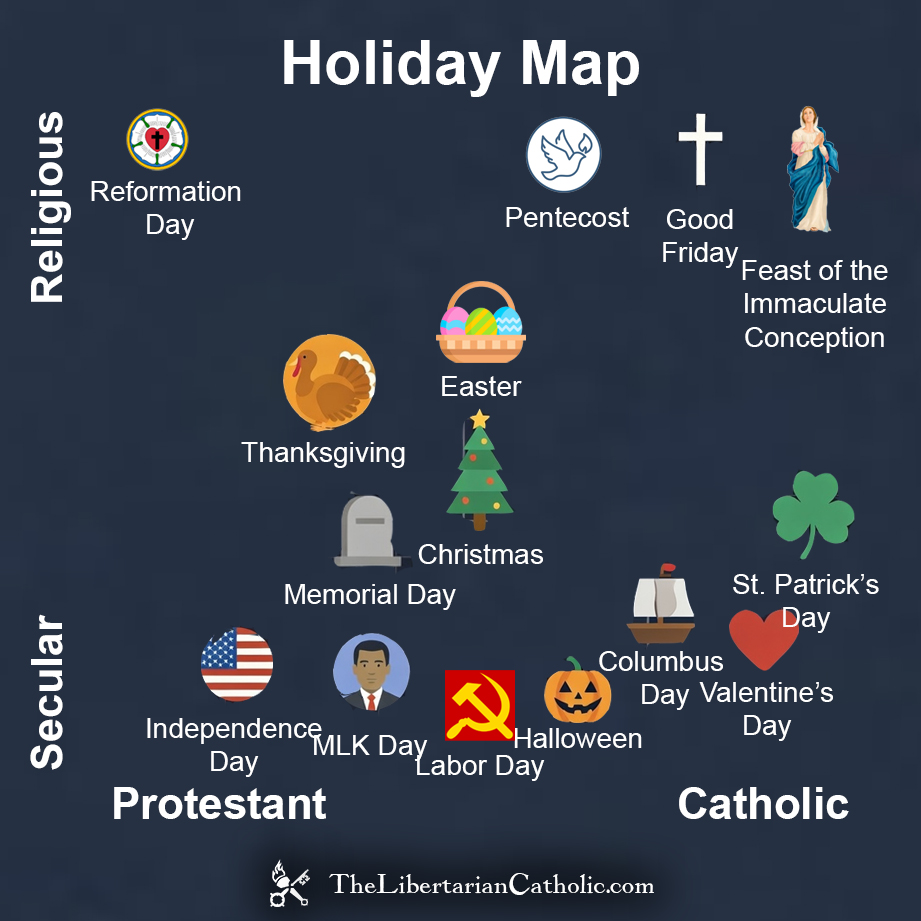
Here’s a conceptual scatter plot chart classifying major widely observed US holidays (federal and cultural) along two axes:
- X-axis: Protestant influence ← → Catholic influence
(Left: More associated with Protestant traditions or history; Right: More associated with Catholic traditions; Center: Shared Christian or neutral) - Y-axis: Secular ← → Religious
(Bottom: Highly secular/civic in modern observance; Top: Strongly religious in origin and practice)
This is a quadrant-style visualization. Holidays are positioned approximately based on their historical origins, religious significance, and current cultural role in the US (where most holidays have become somewhat secularized except for core Christian ones).Quadrants Overview:
- Bottom-Left (Secular + Protestant-leaning): Civic/national holidays with Protestant historical roots (e.g., Puritan influence).
- Bottom-Right (Secular + Catholic-leaning): Holidays with Catholic immigrant influences but largely cultural now.
- Top-Center (Religious + Shared Christian): Core Christian holidays observed by both Protestants and Catholics.
- Bottom-Center (Highly Secular): Purely civic holidays with no strong denominational tie.
Holiday Positions:
- Thanksgiving (Secular, Protestant-leaning): Bottom-left quadrant. Originated from New England Puritan/Calvinist thanksgivings; now a fully secular family/feast day.
- Independence Day (July 4th) (Highly Secular): Bottom-center. Purely civic/patriotic; no religious origin.
- Martin Luther King Jr. Day, Memorial Day, Veterans Day, Labor Day (Highly Secular): Bottom-center. Civic/historical; no religious ties.
- Halloween (Mostly Secular, slight Catholic origin): Bottom-right. Derived from All Hallows’ Eve (Catholic), but now a secular costume/candy holiday.
- St. Patrick’s Day (Secular/Cultural): Bottom-right. Strongly tied to Irish Catholic heritage, but celebrated secularly with parades and drinking.
- Easter (Religious, Shared): Top-center. Core Christian holiday (resurrection of Jesus); observed by both Protestants and Catholics, though Catholics have more liturgical emphasis (Lent, Holy Week).
- Christmas (Somewhat Religious, Shared but secularized): Mid-center (leaning slightly lower on religious axis). Shared Christian origin (birth of Jesus), but in the US, it’s the most secularized religious holiday with widespread non-religious participation (trees, gifts, Santa).
- Good Friday (Religious): Top-center (not a federal holiday, but observed in some states; more emphasized in Catholic and some Protestant traditions).
Note: Few major US holidays fall strongly in the “Catholic” or highly “Religious” extremes because:
- The US has strong Protestant historical influence (e.g., Puritans downplayed many Catholic saints’ days).
- No distinctly Catholic holy days (e.g., Assumption of Mary, All Saints’ Day, Immaculate Conception) are federal or widely observed nationally outside Catholic communities.
- Most religious elements have secular overlays due to cultural diversity.
This chart highlights how US holidays are predominantly secular/civic, with Christian ones being shared rather than denominationally divided. If you’d like a visual image generated to represent this scatter plot (e.g., with labeled points on axes), confirm and I can create one!