 The Libertarian Catholic
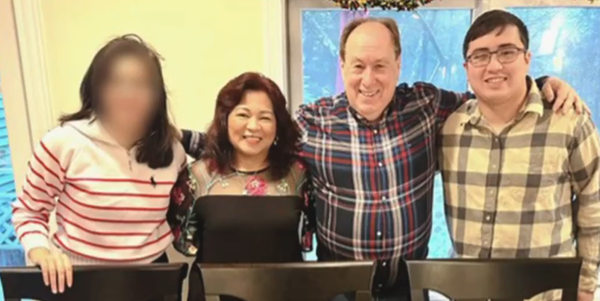
The tragic death of Renee Nicole Good, a 37-year-old U.S. citizen and mother of three, on January 7, 2026, has thrust the nation’s immigration debates into sharp and painful focus. In Minneapolis, during an ongoing large-scale Immigration and Customs Enforcement (ICE) operation targeting undocumented immigrants, Good—a poet, writer, and stay-at-home mom described by her family as compassionate, kind, and deeply committed to supporting her neighbors—was fatally shot by an ICE agent while in her vehicle on a residential street near East 34th Street and Portland Avenue.
The Department of Homeland Security maintains that the shooting was justified in self-defense, claiming Good maneuvered her vehicle in a threatening manner—allegedly attempting to run over agents in an act they described as “domestic terrorism.” Local officials, including Minneapolis Mayor Jacob Frey and Minnesota Governor Tim Walz, along with eyewitness accounts and available video footage, have strongly disputed this narrative, asserting that the footage does not support claims of imminent threat and calling the use of lethal force unjustified and excessive.
Regardless of the ongoing debates over the justification of the shooting, the incident highlights a stark ideological divide in how moral concern is allocated. While media coverage and supporters have portrayed Good as a loving mother who was simply in the area—possibly after dropping off her child or acting as a concerned resident or legal observer—her presence at the scene of an ICE operation amid advocacy for undocumented immigrants has led some to view her as having elevated concern for distant or non-citizen strangers above her proximate familial responsibilities.
The Moral Heatmap
The moral heatmap—a concept popularized in recent years through psychological research—offers a striking visual representation of how different ideological groups distribute their sense of moral obligation and compassion. This “heatmap” originates from studies like the 2019 paper “Ideological differences in the expanse of the moral circle” by Adam Waytz, Ravi Iyer, Liane Young, Jonathan Haidt, and Jesse Graham. In the experiment, participants allocated a fixed number of “moral units” (or indicated their moral concern) across concentric circles representing expanding categories of beings: from immediate family at the center, outward to extended family, friends, acquaintances, fellow citizens, people worldwide, all humans, animals, plants, and even “all things in existence.”
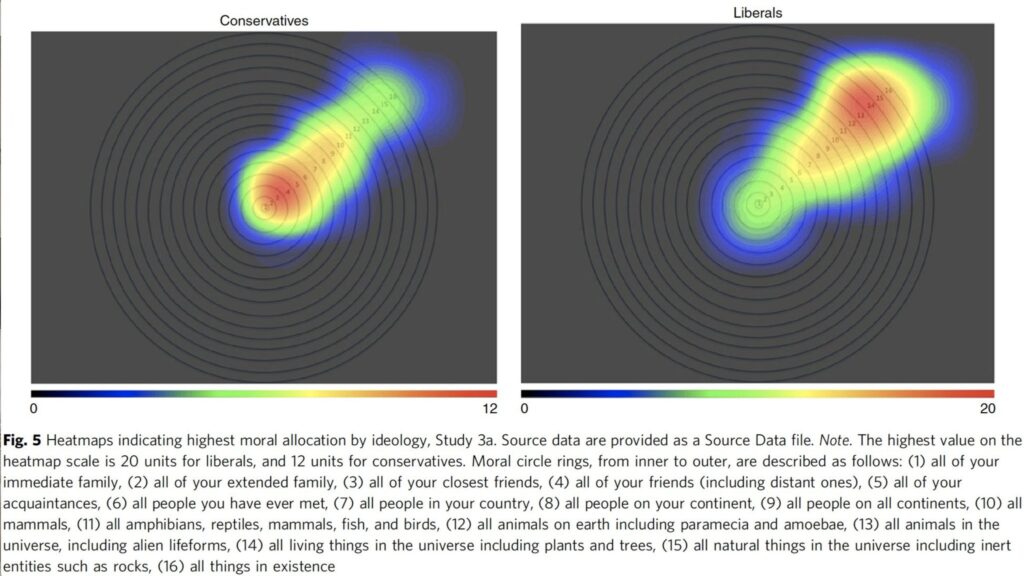
The resulting heatmaps reveal a clear pattern: conservatives tend to concentrate their moral concern in the inner circles—prioritizing family, friends, community, and nation—while liberals spread it more broadly, often peaking in the outer rings that include distant strangers, non-humans, and universal entities.
This allocation reflects deeper differences in moral psychology, as outlined in Jonathan Haidt’s Moral Foundations Theory (detailed in The Righteous Mind). Liberals (in the American political sense) primarily emphasize the “individualizing” foundations of Care/Harm (preventing suffering) and Fairness/Cheating (often as equality), with less weight on “binding” foundations like Loyalty/Betrayal, Authority/Subversion, and Sanctity/Degradation. Conservatives, by contrast, draw more evenly from all foundations, fostering a balanced moral intuition that strengthens group cohesion, tradition, and hierarchy.
Subsidiarity
From a Catholic perspective, the liberal pattern of moral allocation—prioritizing expansive, often abstract universalism at the potential expense of nearer duties—stands in direct opposition to the principle of subsidiarity, a cornerstone of Catholic Social Teaching.
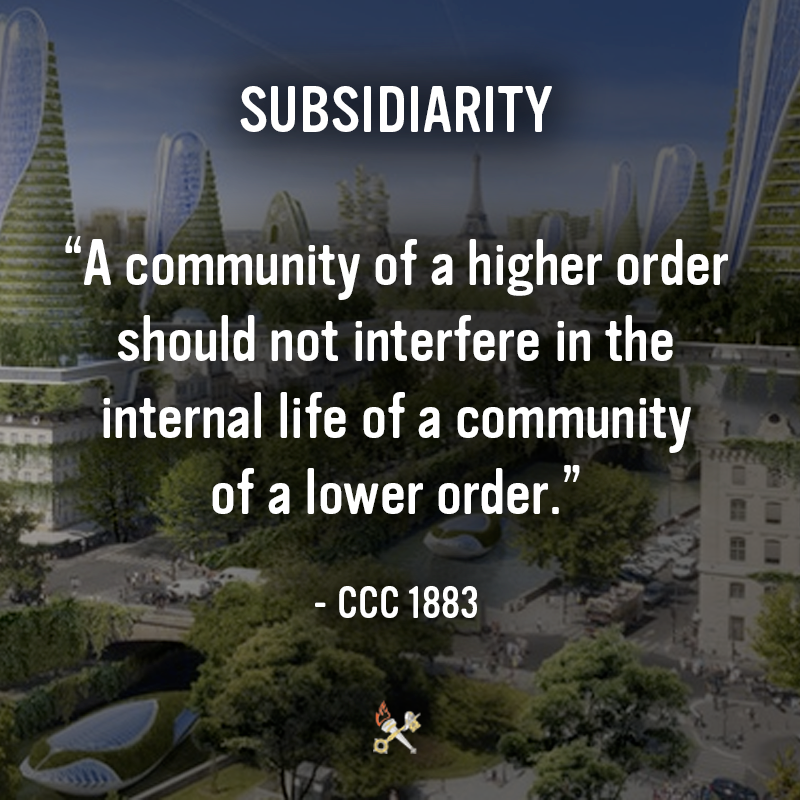
The Catechism of the Catholic Church (CCC 1883) defines subsidiarity as the principle that “a community of a higher order should not interfere in the internal life of a community of a lower order, depriving the latter of its functions, but rather should support it in case of need and help to coordinate its activity with the activities of the rest of society, always with a view to the common good.” Rooted in encyclicals like Pius XI’s Quadragesimo Anno, subsidiarity insists that social functions be handled at the most local, proximate level possible—empowering individuals, families, parishes, and communities first—while higher authorities (like the state) provide aid only when necessary, never usurping what lower levels can accomplish themselves.
This ordered, hierarchical approach to responsibility mirrors the conservative heatmap’s emphasis on proximate circles: moral obligation begins with the family (the “domestic church”), extends to local communities, and then outward through subsidiarity, preserving personal initiative, freedom, and authentic human flourishing. Liberal moral psychology, with its tendency to allocate greater concern to distant or universal entities (e.g., global causes, non-humans, or abstract equality), risks inverting this order. It can promote centralized interventions that bypass or undermine local institutions—families, voluntary associations, churches—leading to a kind of moral flattening where proximate duties are diluted in favor of top-down universal solutions.
Catholic teaching warns against such overreach: excessive centralization threatens human dignity, initiative, and the common good. Subsidiarity is not mere decentralization for its own sake but a moral imperative that fosters solidarity (responsibility for all) through graduated, relational care—starting close to home and radiating outward without neglecting the near for the far.
Hierarchy of Charity
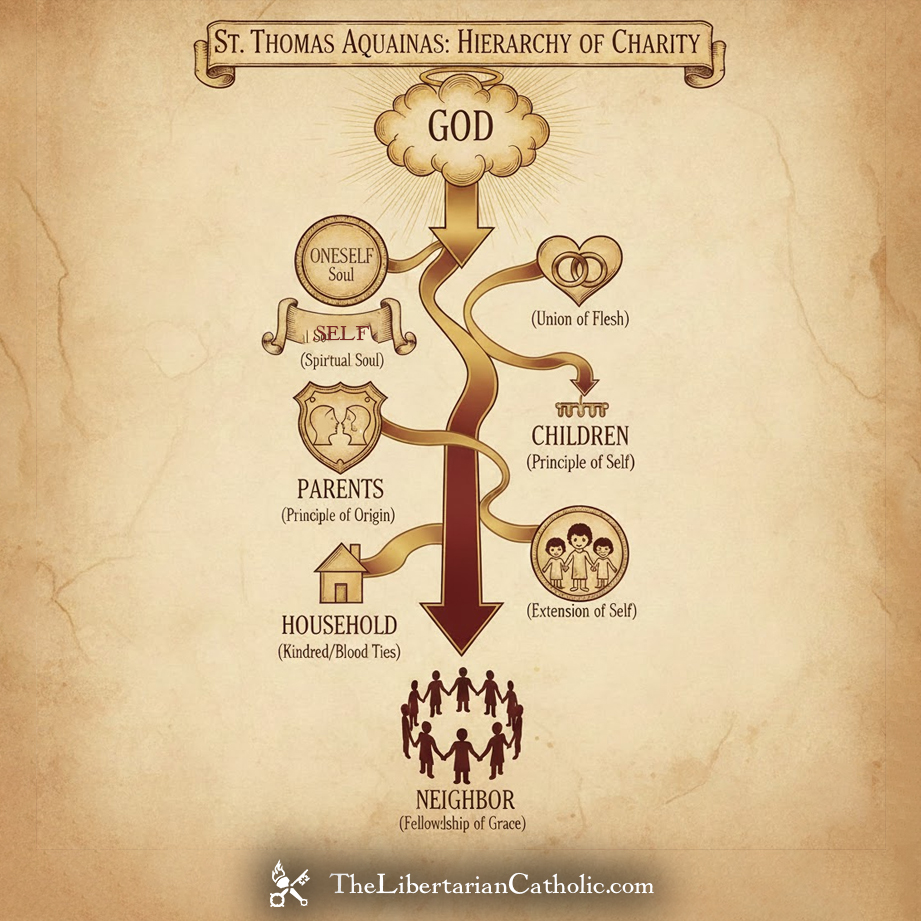
In addition, saints have consistently promoted the moral obligations each person has in accordance with his or her state in life. St. Thomas Aquinas wrote that all human acts must conform to right reason but some are specific to one’s condition, role, and commitments. Duties flow from one’s place in the divine order—parents have duties to children, rulers to subjects, priests to the flock.
In Summa Theologiae, St. Thomas explicitly outlines the hierarchy of charity: First God, then one’s parents, then wife and children, then household, then neighbor.
Anna Maria Taigi was renowned for her extraordinary mystical gifts, including frequent visions, conversations with Jesus and Mary, prophecy, reading of hearts, and especially a miraculous “sun-globe” (a luminous golden sphere) that appeared to her continually for 47 years. In this globe, she could see hidden things, past events, present situations worldwide, and future occurrences—often used to advise cardinals, bishops, popes (including Pius VII and others who consulted her), and dignitaries who visited her home. Her residence became a spiritual center where high-ranking Church figures, nobles, and notables sought her counsel on matters of faith, Church affairs, and personal guidance.
Despite this public role and the constant stream of important visitors (including prelates and influential people drawn by her reputation), Anna Maria always prioritized her primary vocation as a wife and mother. Her husband, Domenico Taigi, was a good but hot-tempered and sometimes difficult man (a porter/servant in a noble household). She was famously docile and obedient to him in all lawful things, viewing her marital duties as her first and highest calling from God—aligning perfectly with the Catholic principle (discussed earlier in our conversation, rooted in Aquinas and catechisms) that moral responsibilities begin with fidelity to one’s state in life.
A well-known anecdote illustrates this precisely: when dignitaries or ecclesiastical visitors were in her home for spiritual discussions or counsel, if her husband called for her (even for something ordinary like his needs or household matters), she would immediately excuse herself, interrupt the meeting, and attend to him without hesitation. She explained that her duty to her husband came before all else, as it was the will of God in her state of life. This act of humble obedience often amazed (and sometimes puzzled) her exalted guests, but it underscored her sanctity: she achieved profound mysticism not despite her domestic life, but through it.
The moral heatmap thus exposes a deep tension between modern liberal intuitions and Catholic social doctrine. While both sides value compassion, the liberal emphasis on expansive, often borderless moral concern can lead to policies that violate subsidiarity by centralizing power and eroding local agency. Conservatives’ inward focus, though not perfect, aligns more naturally with the Church’s vision of ordered love: charity begins at home, strengthened by subsidiarity, to build a just society where every level contributes to the flourishing of persons made in God’s image.
We absolutely are called to help our neighbor and even foreign nationals and criminals, but not to prioritize them over our families.
As libertarians and Catholics, we are called to a moral vision that is truly universal yet deeply rooted—one that honors subsidiarity’s wisdom, empowers the local, and ensures that moral obligation flows in harmony with human nature and divine order, not against it.