 The Libertarian Catholic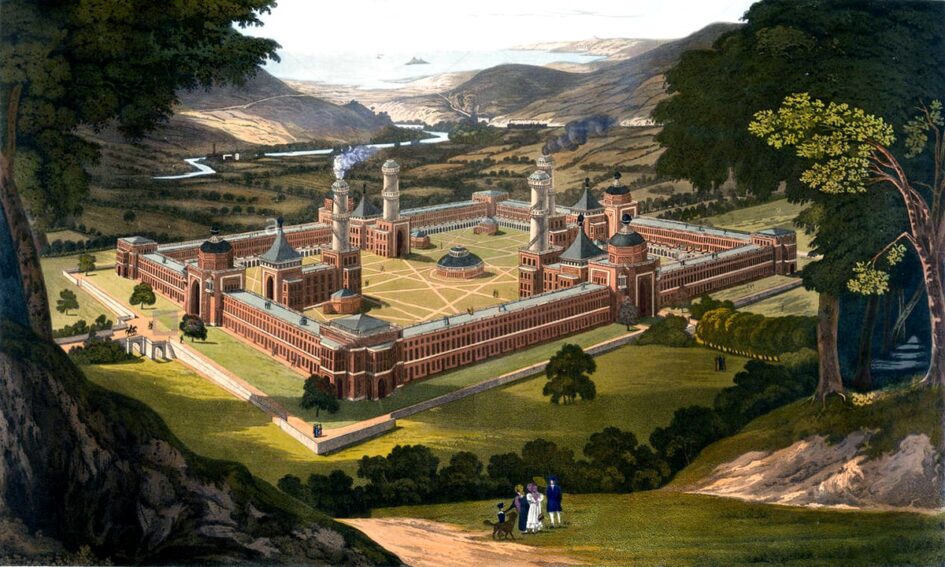
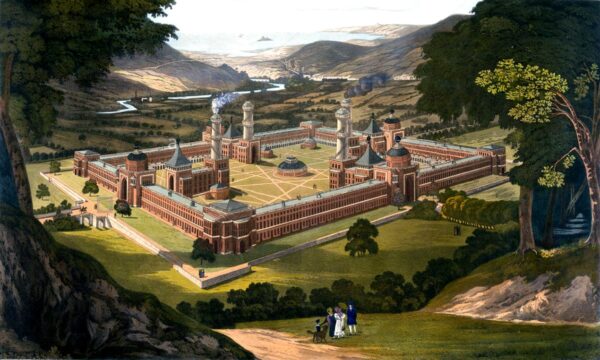
In the early 19th century, the small settlement on the Wabash River in Posey County, Indiana, known first as Harmonie and later as New Harmony, became the site of two successive experiments in communal living. The second of these—the secular, socialist venture led by Welsh industrialist and social reformer Robert Owen—lasted only about two years (1825–1827) and ended in economic collapse, social discord, and the rapid abandonment of communal principles. Two hundred years after the Pilgrims’ socialist failure at Plymouth, New Harmony’s failure remains one of the clearest early American illustrations of the impossibility of implementing atheistic socialism in society.
The Harmonist Foundation (1814–1824)
The groundwork was laid by a different group. In 1814, German Pietist Separatists known as the Harmonists (or Rappites), led by George Rapp, purchased roughly 20,000 acres of wilderness land along the Wabash and established the town of Harmonie. They practiced communal ownership of property, celibacy, and a disciplined, religiously motivated work ethic aimed at Christian perfection while awaiting the Second Coming. Despite early hardships including malaria, the Harmonists transformed the frontier into a prosperous agricultural and manufacturing community with solid brick and frame buildings, mills, vineyards, and workshops. By the mid-1820s they numbered several hundred and had created a functional, self-sustaining settlement.
Seeking better commercial opportunities and isolation farther east, the Harmonists sold the entire town and lands in 1825 and returned to Pennsylvania, where they founded Economy. Sources commonly place the sale price in the range of $125,000 to $150,000 (with some accounts of total consideration including stock and provisions reaching higher). The buyers were Robert Owen and his financial partner, the Scottish geologist and philanthropist William Maclure.
Owen’s Vision and Arrival
Robert Owen (1771–1858) had achieved success as a cotton manufacturer at New Lanark in Scotland, where he improved workers’ conditions, limited child labor, and promoted education. He developed broader ideas for reforming society through planned communities based on common ownership, cooperative labor, rational education. He believed environment shaped character and that a “New Moral World” could be demonstrated by example.
“I now declare to you and to the world that man up to this hour has been in all parts of the earth a slave to a trinity of the most monstrous evils that could be combined to inflict mental and physical evil upon the whole race,” Owen once said. “I refer to private property, absurd and irrational systems of religion and marriage founded upon individual property.”
Owen set out to prove his atheistic socialist philosophy correct by purchasing the ready-made town, renaming it New Harmony, and making it a thriving socialist utopia. He invited “any and all” to join the Community of Equality. Residents were to share property, work according to ability, and receive according to need (or, in practice, through various labor-credit systems). Education was to be free and progressive; social classes and private wealth were to be abolished. In January 1826 a group of scientists, educators, and reformers arrived by keelboat from Pittsburgh on the Philanthropist—the celebrated “Boatload of Knowledge.” Among them were Maclure, zoologist Thomas Say, naturalist and artist Charles-Alexandre Lesueur, and others. The population swelled to roughly 700–1,000 at its peak, mixing idealists, intellectuals, artisans, and farmers of varying skill.
Superstitious religious traditions were laughed at, private property was abolished, and even children were raised by the community instead of in family units. Owen’s rationalist outlook treated conventional religion as an obstacle to progress and a source of irrational belief; communal ownership replaced individual holdings; and the upbringing of the young was to be a collective responsibility, with early education and care organized by the community rather than left solely to parents.
Rapid Decline and Dissolution
Problems appeared almost immediately. Agriculture and maintenance lagged; fields went unattended and fences unrepaired. Housing became overcrowded. Skilled laborers and practical farmers were in short supply relative to theorists and those unaccustomed to frontier work. Members complained about unequal effort: those who worked hard saw others receive similar shares with less contribution. Religious differences, personality conflicts, and disagreements over governance and the role of private incentives multiplied. Owen’s open hostility to traditional religion alienated some participants.
Production consistently failed to match consumption. Debts mounted. Reorganizations—including dividing the settlement into smaller societies that traded among themselves—did not solve the underlying issues. By early 1827 the experiment was unraveling. Owen formally dissolved the communal arrangement. He had lost a large portion of his fortune (contemporary estimates and later accounts often cite losses equivalent to tens of thousands of pounds or roughly $150,000–$200,000 ($5-7 million in today’s money). Smaller residual groups tried to continue on leased land but soon fragmented further. By 1828–1829 individualism and private property had largely returned; the socialist community as such was finished.
Robert Dale Owen later described the participants as “a heterogeneous collection of radicals, enthusiastic devotees to principle, honest latitudinarians, and lazy theorists, with a sprinkling of unprincipled sharpers.” Early American libertarian Josiah Warren, an early participant, concluded that the demand for conformity clashed with human diversity of tastes and purposes, and that equal remuneration drove out the skilled and industrious.
Contrasts and Legacies
The contrast with the preceding Harmonist decade is instructive. The Rappites’ religious cohesion, clear hierarchy, disciplined labor, and acceptance of communal rules sustained a productive settlement for ten years. Owen’s secular, open-admission model lacked comparable binding commitments and effective incentives for production. Classic problems of collective ownership—insufficient motivation to work hard when rewards were equalized, difficulty coordinating diverse people, and weak mechanisms for enforcing contribution—quickly asserted themselves.
Despite the social and economic failure of the Owenite community, New Harmony left positive legacies. Under Maclure’s influence it became an early center for scientific research (especially geology and natural history) and progressive education. Innovations associated with the period include early infant schools/kindergartens, co-educational public schooling, a free library, and scientific societies. Several of Owen’s children and many scientists remained and contributed to American intellectual life. The town itself survived as a quiet historic community and is today a National Historic Landmark District preserving buildings from both eras.
New Harmony stands as a concrete early test of utopian socialist principles on American soil. It demonstrated that good intentions, intellectual talent, and substantial capital were not sufficient to overcome the practical challenges of abolishing private property and equalizing rewards without robust incentives, shared purpose, and competent ongoing management. The experiment collapsed within two years, leaving a cautionary historical record rather than a working model of the “New Moral World.”