 The Libertarian Catholic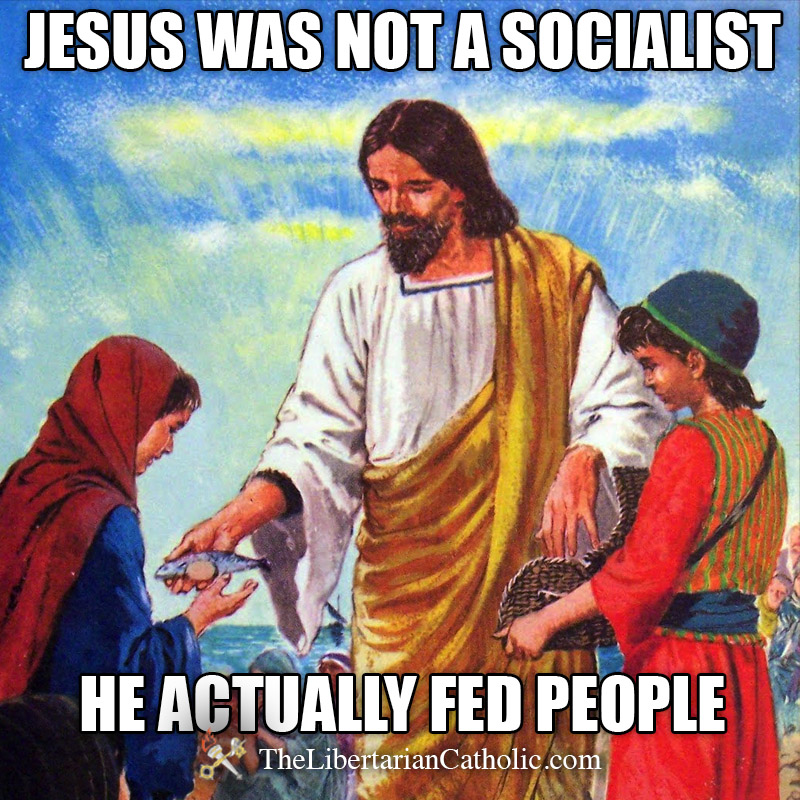
The claim that Jesus was a socialist is a modern projection that misreads both the historical Jesus and the nature of socialism. Jesus lived in first-century Roman-occupied Judea, long before the concepts of capitalism or socialism existed as economic systems. He offered no political blueprint for government, taxation policy, wealth redistribution by the state, or collective ownership of the means of production. His teachings centered on the Kingdom of God, personal repentance, love for God and neighbor, and eternal life—not earthly economic reorganization through coercion.
Socialism vs. Jesus’ Teachings: Core Distinction
Socialism, at its root, involves government (or collective) control or heavy redistribution of resources, often through compulsory taxation, regulation, and state power to achieve material equality. It relies on force: the state takes from some (via taxes or seizure) and gives to others according to bureaucratic decisions. Jesus emphasized voluntary personal transformation, generosity from the heart, and individual accountability before God. He never called for Caesar (the state) to seize wealth, raise taxes for welfare programs, nationalize property, or enforce economic equality. When given the chance to intervene in a property dispute, Jesus refused:
“Teacher, tell my brother to divide the inheritance with me.” Jesus replied, “Man, who appointed me a judge or an arbiter between you?” Then he said to them, “Watch out! Be on your guard against all kinds of greed; life does not consist in an abundance of possessions.” (Luke 12:13-15)
This was a direct rejection of playing the role of economic enforcer.
Voluntary Giving, Not Forced Redistribution
Jesus and the New Testament consistently promote charity as a voluntary act motivated by love, faith, and the Holy Spirit—not state compulsion. Examples include:
- The rich young ruler (Matthew 19:16-22): Jesus told this specific man to sell his possessions and give to the poor as a test of his heart and willingness to follow Him. This was personal discipleship, not a universal policy for society or a call for government action. Jesus did not instruct others to do the same or demand the state confiscate the man’s wealth.
- Zacchaeus (Luke 19:1-10): The tax collector voluntarily gave half his possessions to the poor and repaid fourfold what he had cheated—out of repentance and joy, not coercion.
- The Good Samaritan (Luke 10:25-37): An individual used his own resources to help a stranger. The lesson is personal responsibility and mercy, not lobbying Rome for social programs.
- Early church sharing (Acts 2:42-47; 4:32-35): Believers voluntarily sold property and shared with those in need within the Christian community. It was not a commune imposed by law, and Ananias and Sapphira were condemned not for keeping property, but for lying about their voluntary gift (Acts 5:4 explicitly affirms they had the right to keep it). Paul later instructed cheerful, voluntary giving (2 Corinthians 9:7: “Each of you should give what you have decided in your heart to give, not reluctantly or under compulsion, for God loves a cheerful giver”).
Nowhere does Jesus advocate empowering the state to “care for the poor” through taxation or bureaucracy. Caring for the needy was the responsibility of individuals, families, and the believing community—not the Roman Empire or any successor government.
Wealth, Property, and the Heart
Jesus warned strongly against the love of money and the spiritual dangers of wealth (“It is easier for a camel to go through the eye of a needle than for someone who is rich to enter the kingdom of God,” Mark 10:25). He condemned greed, hoarding, and exploitation. However, these were critiques of the human heart and misplaced priorities (“You cannot serve both God and money,” Matthew 6:24), not calls for class warfare or abolishing private property.
- Jesus upheld property rights: He condemned theft (Matthew 19:18), defended the owner’s right to pay agreed wages in the Parable of the Workers in the Vineyard (Matthew 20:1-16—the landowner says, “Don’t I have the right to do what I want with my own money?”), and told people to “render to Caesar what is Caesar’s” (Matthew 22:21), implying legitimate spheres of ownership and limited state authority.
- Parables like the Talents (Matthew 25:14-30) commend wise stewardship, investment, and productivity—not equal distribution or punishing success.
- Jesus Himself lived simply but accepted support from people with means (Luke 8:1-3) and was buried in a rich man’s tomb.
The issue for Jesus was idolatry of wealth, not wealth itself. Socialism often fuels envy and coercion in pursuit of material equality; Jesus called for inner renewal that produces generosity without resentment.
Kingdom of God vs. Earthly Politics
Jesus’ message was radically spiritual and eschatological: “My kingdom is not of this world” (John 18:36). He proclaimed good news to the poor (Luke 4:18), but in the context of liberation from sin, oppression of the soul, and the coming judgment—not a political manifesto for wealth redistribution. Attempts to recast Him as a proto-socialist ignore this. He healed, fed multitudes miraculously, and taught personal ethics, but He overturned tables in the temple for corruption (not for profit-making per se) and focused on repentance and faith.
Projecting modern ideologies onto Jesus (“Jesus was a socialist before socialism existed”) reduces the eternal Son of God to a partisan mascot. He transcends left and right. Christians are called to voluntary generosity, justice, and care for the vulnerable (James 1:27; Galatians 6:10), which has historically thrived in free societies where people retain the fruits of their labor and choose to give. Forced systems, by contrast, often produce dependency, resentment, and economic failure—outcomes Jesus never endorsed.
In summary, Jesus called people to radical love, self-denial, and stewardship under God. Socialism substitutes state power for personal virtue and divine accountability. The two are incompatible at the foundational level: one transforms the heart voluntarily; the other compels outcomes through law. Jesus was not a socialist—He was (and is) the Lord who demands our whole lives, including how we use whatever resources we have.