 The Libertarian Catholic
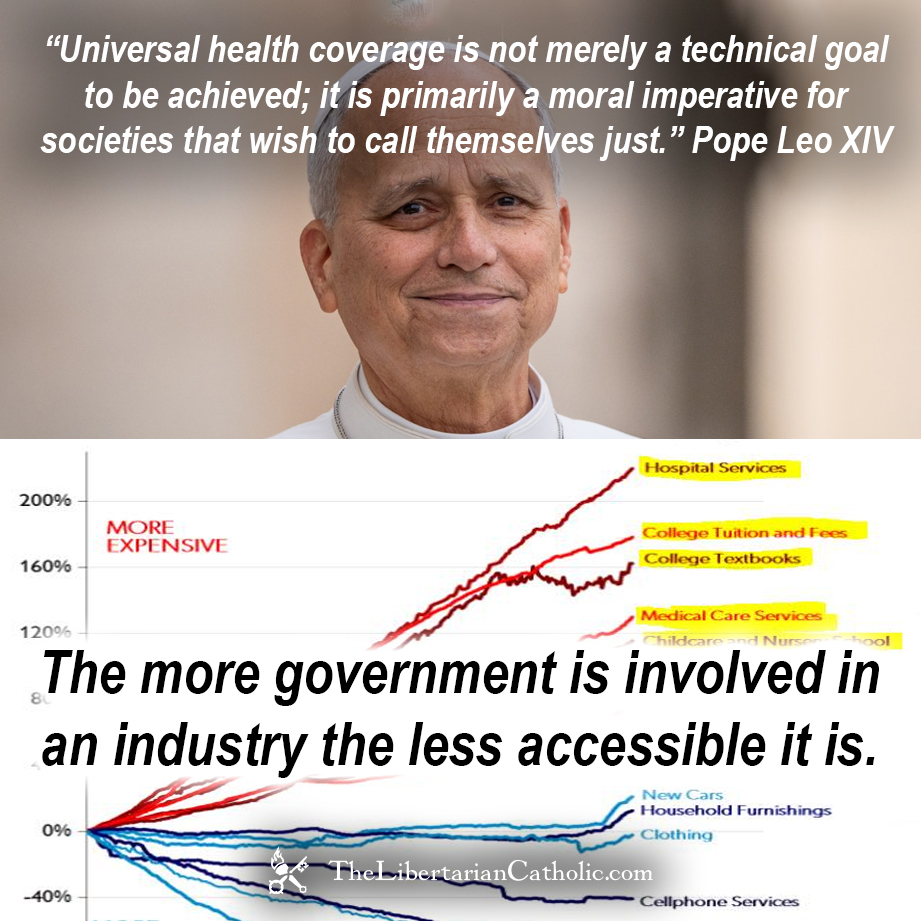
There is a persistent pattern in healthcare policy that should unsettle anyone who values broad access to medical care. The more government inserts itself—through subsidies, mandates, price controls, insurance regulations, and direct provision—the higher costs climb and the more ordinary people find themselves priced out or stuck in queues. Declaring healthcare a “positive right” (a claim on others’ resources rather than a liberty against interference) is one of the surest ways to reduce real access to it.
In a normal market, prices coordinate supply and demand. Consumers face trade-offs; providers compete on cost and quality; innovation responds to willingness to pay. Healthcare in the United States has long departed from that model. Third-party payment—employer insurance, Medicare, Medicaid, and layered subsidies—insulates patients from prices. When someone else pays most of the bill, demand rises and price sensitivity falls. Providers respond by raising prices or delivering more intensive services. The result is the familiar cost spiral.
Data illustrate the scale. U.S. health spending now approaches or exceeds 17 percent of GDP—far higher than peer OECD countries—and has grown faster than inflation and wages for decades. Public programs and government-influenced private insurance dominate financing. Analyses from sources such as the Cato Institute note that government effectively controls a very large share of U.S. health spending, often higher than in explicitly socialized systems. Policies including certificate-of-need laws, site-of-service payment differentials, and programs like 340B encourage consolidation and higher prices rather than competition. Hospital prices have risen several times faster than general inflation, and commercial premiums follow. Rising prices act like a payroll tax, reducing employment and take-home pay, especially for lower- and middle-income workers.
Historical expansion tracks the same dynamic. Before Medicare and Medicaid in the mid-1960s, health spending was a much smaller share of the economy. As public programs and private insurance coverage expanded, out-of-pocket spending’s share fell while total expenditures soared. Insurance mandates and community-rating rules further detached premiums from individual risk, pushing costs onto healthier people and the broader tax base. Subsidies intended to make coverage “affordable” often simply finance higher underlying prices.
The logic of positive rights intensifies the problem. A negative right—freedom from coercion—requires others mainly to refrain from interfering. A positive right to healthcare requires someone to produce and deliver services, usually financed by taxation or forced cross-subsidies. Once politicians promise universal or near-universal provision, they face unbounded demand against finite resources. The political response is rarely pure market pricing; it is rationing by waiting lists, restricted provider supply, or suppressed reimbursement rates that drive doctors and capital out of the system or into the remaining private sector.
Countries that treat healthcare as a near-absolute entitlement illustrate the trade-off. Canada’s single-payer system produces median waits from general-practitioner referral to treatment measured in months—recently around 28 weeks nationally, longer for orthopedics and in some provinces. The United Kingdom’s National Health Service has multi-million-person waiting lists for routine care, with large numbers waiting beyond targets or even a year. These systems often spend less per capita than the United States, yet patients trade money barriers for time barriers. Emergency care is typically prompt; elective and specialist care is not. Capacity constraints—fewer physicians, beds, or scanners per capita relative to spending in some comparisons—persist despite high tax financing.
Even in the mixed U.S. system, layers of government intervention produce hybrid failures: high prices for the privately insured, narrow networks, high deductibles that create de-facto rationing by ability to pay at the point of service, and administrative complexity that consumes resources without improving outcomes. Consolidation, partly incentivized by payment rules and regulations, further reduces competition and raises prices.
None of this denies that markets can fail or that some safety net is defensible. Catastrophic coverage, targeted aid for the genuinely indigent, or transparency requirements can address real problems without the broad distortions of comprehensive government involvement. The irony is that the most ambitious efforts to guarantee access through positive rights and heavy regulation reliably produce the opposite: higher costs that price more people out of timely care, or queues that ration by time and political priority rather than individual need and willingness to pay. Expanding the claim on others’ labor and capital does not magically expand the supply of doctors, nurses, hospital beds, or innovative treatments. It primarily expands the bureaucracy that allocates scarcity.
The evidence points to a consistent conclusion. Treating healthcare as a positive right and expanding government’s role has not delivered the promised universal abundance. It has delivered higher prices, longer waits, and reduced access for the very people the policies claim to protect. Real improvement requires restoring price signals, competition, and individual responsibility rather than further insulating patients and providers from the costs of their decisions.