 The Libertarian Catholic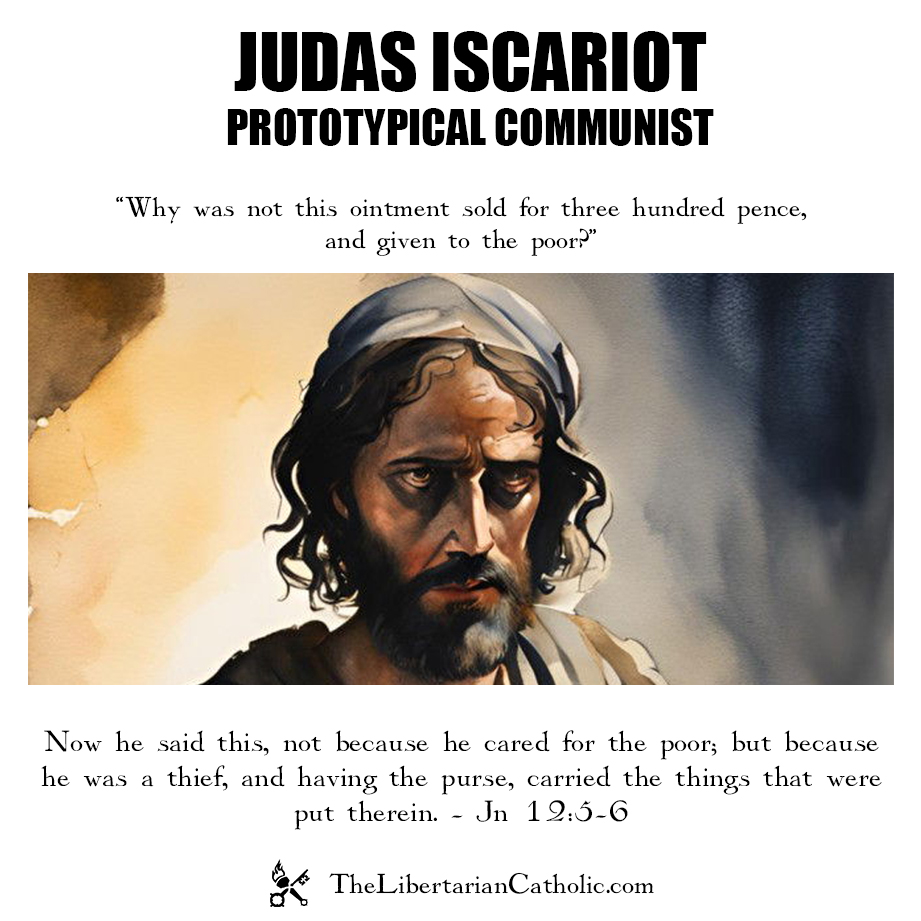
In John 12:5-6, Judas objects to Mary’s extravagant anointing of Jesus:
“Why was this fragrant oil not sold for three hundred denarii and given to the poor?”
This he said, not that he cared for the poor, but because he was a thief, and had the money bag; and he used to take what was put in it.
Here Judas perfectly embodies the prototypical communist bureaucrat (or socialist apparatchik) in three key ways:
- He controls the common purse
Judas was the official treasurer of Jesus’ small apostolic community. All resources were pooled together under his management — a miniature version of centralized economic control. He didn’t own the money personally, but he had exclusive administrative power over it. - He weaponizes concern for “the poor” as a rhetorical tool
Instead of genuine compassion, Judas immediately frames private generosity (Mary’s sacrificial act) as selfishness toward the collective. “Why wasn’t this given to the poor?” is classic redistributionist rhetoric: any resource not flowing through the central authority is portrayed as immoral. He doesn’t actually help the poor; he uses them as a moral cudgel to shame others and increase his own control. - He personally enriches himself from the system he administers
The text explicitly reveals the hypocrisy: Judas was stealing from the common fund he was entrusted to manage. The bureaucrat who preaches equality, social justice, and sacrifice for the collective is quietly siphoning off resources for his own benefit — the hallmark of corrupt central planners throughout history.
In short, Judas wasn’t opposed to wealth itself — he was opposed to wealth that bypassed his bureaucratic control. He demanded that private devotion and resources be liquidated and redirected through the official “people’s fund”… which he then looted.
This makes him the biblical prototype of the socialist/communist administrator:
- Talks endlessly about the poor and equality
- Demands centralized control of all resources
- Secretly lives off the system he claims to administer for the “greater good.”
Jesus’ response in verse 7–8 (“The poor you always have with you…”) directly undercuts this false piety, exposing it for what it is.