 The Libertarian Catholic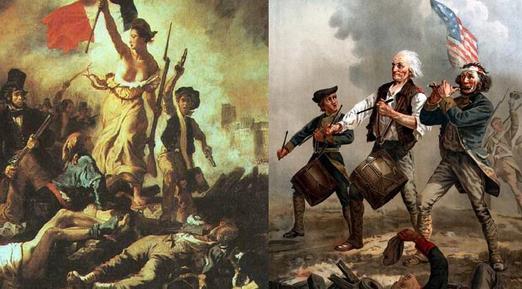
Comment by Stefano Pietro Cicerone on The Libertarian Catholic FB:
It is curious to note how streams of ink have been poured to surreptitiously convey the idea of consanguinity between the French Revolution and the American Revolution. Apparently so similar in their premises from the rights of man, passing through republican forms, until the aspiration of the People to break the yoke of tyrants; and yet so different in method and results.
The French Revolution, in which all the prodigies of today’s culture of annihilation and destruction can be appreciated, ended up replacing a monarchy with a tyrannical power far greater and more pervasive, that of the modern state in its final version, which claims to centralize in itself every aspect of life and society.
The political matrix that led the process is that of Jacobinism, where mobilized masses – in a perpetual state of emergency/excuse – from manipulators skilled in rhetoric consider the use of violence in relation to the miraculous end of the “common good” to be legitimate. Its axiom is precisely the idea that there exists a general good of which few are aware; the knowledge of this general good authorizes those who know it to violate life, property, and moral integrity of those who must be bent to realize it. This results, therefore, in the obvious betrayal in relation to the initial ends for which it was called the Jacobin revolution.
In contrast, in 1776 in Philadelphia, the American Colonies, considering the tax imposition resulting from a political obligation decided upon their own skin by others in Westminster (regardless of the fact that it was a Parliament) to be self-determined in order to become independent from the English oppressor, did not replace a tyrant with a worse tyranny than the previous one.
The American Founders, in fact, believed that governments were instituted among men not so much to realize, according to a constructivist logic, the higher purposes imposed by a so-called “general will,” but rather as solemnly venerated by Jefferson in the Declaration of Independence – according to a clear Lockian paradigm – that “their just powers” derived from the munus of protecting and securing those inalienable natural rights to life, freedom, and private property, as well as the fortunate formula of the search for happiness by every power that wished to deny them.
In other words, according to the legislators of the Continental Congress, denying these rights for a government was equivalent to losing the source of legitimacy for the exercise of power, thereby authorizing the People to remove it.
Another striking difference between July 4 and July 14, which seems necessary to address in this session and which is particularly pressing in the difficult times we are living in, is the religious element in the institutional structure.
Edmund Burke, in his monumental Reflections on the French Revolution, states: “within us we have always known that religion (Christian) is the foundation of civil society and the source of all good and comfort.”
Well, while the Jacobite frenzy mainly resolved into the creation of an anti-Christian society, we cannot help but remember the martyrdom of the Carmelite women in Compiègne among the most heinous revolutionary crimes; the American independence activists, however, were in their totality convinced that they were Christians.
The French Revolution had the serious responsibility of having excommunicated and denied God in the construction of the European legal system. By eliminating God as the supreme source of human infinite dignity, a palenesis was achieved, in which the anchoring of human rights rests on the positive law extended by the authority of the State and not on natural law.
On the contrary, as reiterated by Speaker Mike Johnson precisely on the occasion of the last anniversary of American independence, today and always in the United States, fundamental rights are not granted by the government, but they precede it, descending directly from the Creator and thus are inalienable.
In one of his recent publications, according to Prof. Marco L. Bassani, “Europe thought of freedom as the conquest of man against God, America as a gift of God to man,” nothing could be truer!